Decision Modeling (DMN)
The value and adoption of decision modeling have accelerated since the Decision Model & Notation (DMN) open standard was published by the OMG in 2015.
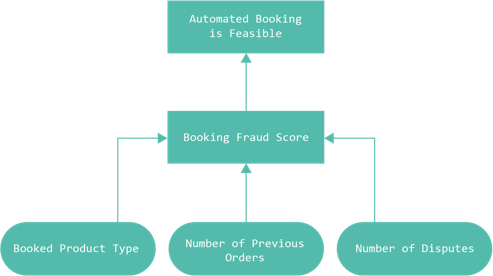
A decision model depicts business logic with two views. The first, a decision requirements diagram, captures the relationships between parts of your decision-making logic.
The second, a decision logic model, defines that logic, typically using a decision table.

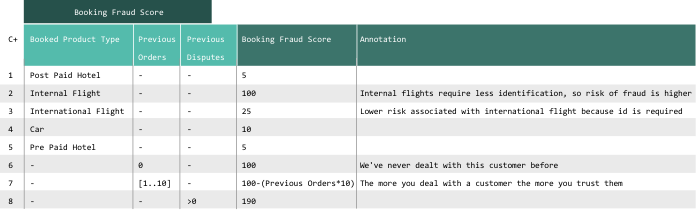
These two views work together to formalize, structure and automate business decision-making.
Benefits of Decision Modeling for Automated Decisions
Explicit modeling of business decisions with DMN, that acts both as documentation and the basis of execution, has been long associated with better:
- Transparency: the benefit of making your business logic explicit in a manner that is easily understood by all stakeholders. Allowing models to be reviewed and improved based on a solid foundation of understanding.
- Explainability/Accountability: the power for decisions to explain their outcomes and the rationale for these outcomes based on internal policies, regulations and legislation.
- Governance: the ability for stakeholders to control the evolution of business logic as a long-term asset, so that necessary changes can be made, reviewed and released in a controlled manner with reference to any compliance regulations being supported.
- Behavioural Control: the understanding of the behavioural consequences of all changes you make to business logic in real-time, being confident that any changes made result in no collateral damage. This is achieved by generating a set of test cases and showing how the results change across the entire set as you adjust the logic.
- Regression analysis: the capability to measure and predict the impact of changes in decision logic to profitability, customer retention, operational speed, cost and other important business metrics.
Sweet Spot
Decision modeling can be beneficial in many areas, particularly areas needing to handle:
- High value
- High transparency
- Scalability
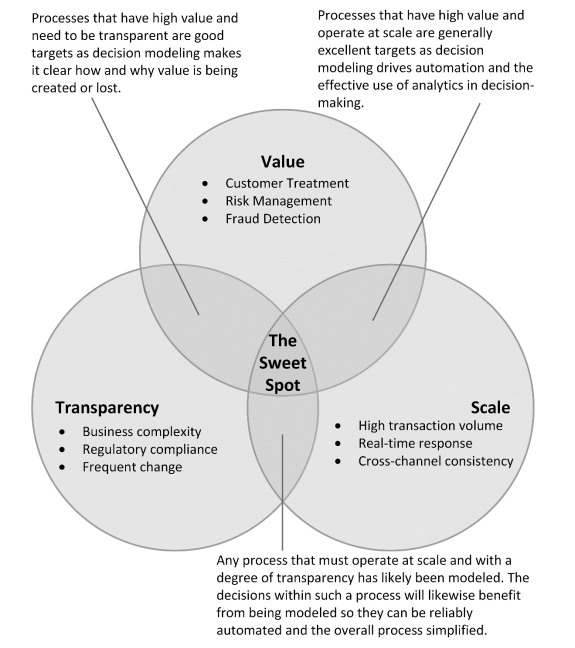
Real-World Decision Modelin g with DMN, James Taylor and Jan Purchase, 2023
OMG Example
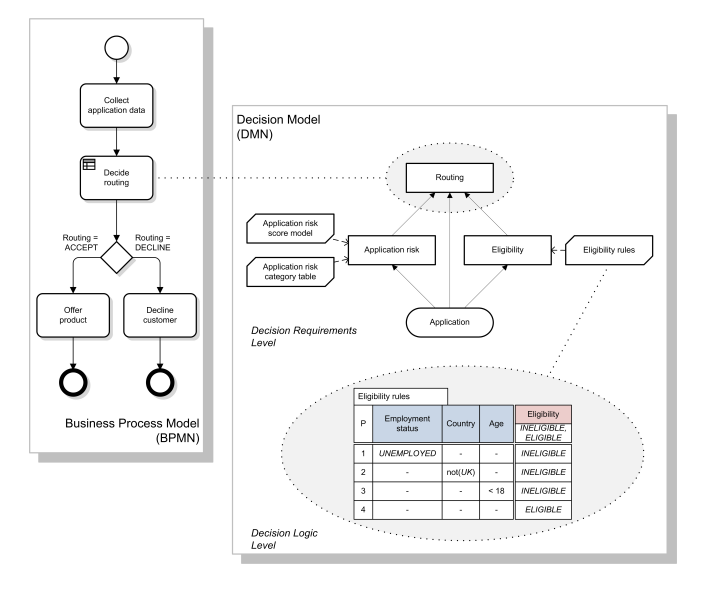
The OMG provides this example to show how decision modeling can be used with BPMN and decision tables. Here you can see how a decision model to accept/decline an application is used within a business process – and a decision table is used to specify the logic for eligibility with the decision model.
Further Reading
- Real-World Decision Modeling with DMN, James Taylor and Jan Purchase, 2023
- DMN Method & Style, Bruce Silver, 2018
- Decision Automation Organization
- Decision Management Community